

September 23, 2026
Freight Forwarder Liability in the UAE: When an Agent Can Be Treated as the Carrier
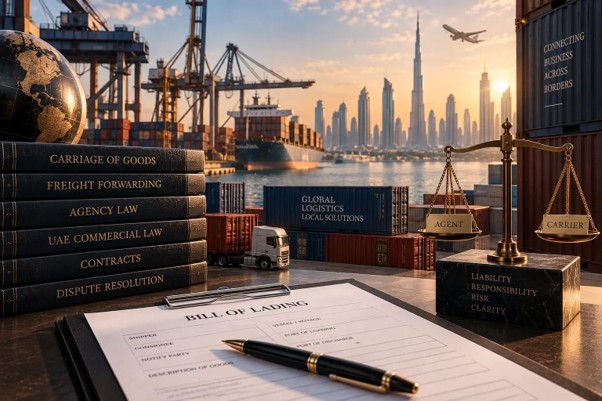
Shipping and maritime law can change a forwarder’s liability by role.
A freight forwarder may book sea carriage, arrange customs formalities, coordinate road delivery, organise storage and issue transport documents. When cargo is lost, damaged or delayed, the dispute often begins with one question: was the forwarder simply arranging services, or did it undertake responsibility for the carriage itself?
Federal Decree-Law No. 43 of 2023 Concerning the Maritime Law makes that distinction important. Article 199 recognises different roles for a freight forwarder depending on what it has undertaken to do. For businesses instructing law firms in UAE on logistics disputes, the starting point should be the actual transport chain rather than the job title used in the contract.
The Contract Must Match What the Forwarder Promised
Where a freight forwarder undertakes to provide the carriage service, Article 199 can treat it as a carrier contracting with the consignor. The position can remain important even where one or more actual carriers perform the physical movement. In other circumstances, a forwarder may act as a commission agent or as the consignor’s representative.
A logistics law firm should therefore examine the forwarding agreement, booking confirmations, bills of lading, invoices and written instructions. The key questions are who promised to move the cargo, who appointed the performing carrier and in whose name the arrangements were made. A label such as “agent” or “forwarder” should not be read separately from the services actually undertaken.
Multimodal Shipments Can Split the Liability Analysis
A shipment may move by truck, warehouse, port terminal and vessel before another road leg completes delivery. The Maritime Law expressly regulates multimodal carriage by sea. Article 190 requires the multimodal carriage contract to be in writing and provides for a carriage document in paper or electronic form.
Article 197 distinguishes between damage arising during the sea stage and damage arising during another mode. Where loss, damage or delay occurs during the sea stage, or the location of the damage is unknown, the sea-carriage liability provisions apply. If the problem arose during another transport stage, the rules applicable to that mode become relevant. A transport law firm reviewing the claim should therefore identify where custody changed and where the loss most likely occurred.
The Bill of Lading Is More Than Shipping Paperwork
For carriage of goods by sea, Article 156 provides that the bill of lading is evidence that the carrier received the cargo in the condition stated and undertook to deliver it to the person entitled to receive it. Article 157 also gives the bill of lading and its conditions evidential importance in proving the carriage contract. Electronic bills of lading can have the same probative force as paper versions where the statutory requirements are met.
Cargo information matters too. Article 169 requires the consignor to provide cargo data in writing and to notify the carrier where goods are dangerous, together with information needed for safe handling. A shipping law firm may therefore need to review the cargo description, weight, quantity, condition, dangerous-goods declarations and instructions given before loading.
Carrier Liability Has Limits, but So Do Exclusion Clauses
Article 175 makes the carrier liable for loss or damage occurring between receipt of the cargo and delivery unless the carrier proves that it, its subordinates and agents took all reasonable measures to prevent the damage or that taking those measures was impossible. The law also contains statutory limits on compensation in specified circumstances.
Those limits do not make every exclusion clause enforceable. Article 179 treats provisions that exempt the carrier from liability for specified breaches, or reduce liability below the statutory maximum, as invalid. Logistics lawyers reviewing a claim should therefore consider both the contractual wording and the mandatory rules that may restrict what the parties were entitled to exclude.
A Cargo Claim Can Be Lost Through Delay
Article 187 provides that, where there is denial and no legally admissible excuse, cases arising from carriage by sea will not be heard after one year from the date the cargo was delivered or should have been delivered. Article 198 contains a similar one-year rule for cases arising from a multimodal carriage contract.
Early evidence preservation is therefore important. Delivery records, cargo surveys, photographs, temperature logs, seal information, warehouse records and correspondence can help establish when and where damage occurred. Parties should not assume that commercial discussions alone preserve a claim. The procedural position should be checked while there is still time to act.
Conclusion: Review the Liability Chain Before the Shipment Moves
Freight-forwarding and transport contracts should clearly address the service being provided, authority to appoint subcontractors, custody, insurance, liability allocation, claims notices, documentation and dispute resolution. Problems become harder to resolve where the contract describes one role but the parties operate in another way.
AY Advocates advises on logistics and transport agreements, maritime matters, commercial claims and related disputes. The work calls for the sector understanding businesses expect from top law firms in Dubai and top legal firms in Dubai, particularly where several contracts and carriers sit behind one shipment.
Cargo delayed, damaged or missing in a UAE logistics chain?
Speak with AY Advocates about freight-forwarding agreements, carriage disputes, cargo claims and the legal steps available before evidence is lost or a filing deadline approaches.
Frequently Asked Questions
1. Can a freight forwarder be treated as a carrier in the UAE?
Yes. Article 199 of the Maritime Law provides circumstances in which a freight forwarder that undertakes to provide carriage services can be treated as a carrier contracting with the consignor. The precise position depends on the service undertaken and the contractual arrangement.
2. Does calling a freight forwarder an “agent” prevent it from having carrier liability?
No. The description used by the parties is not the only consideration. The agreement and the role actually undertaken should be reviewed to determine whether the forwarder acted as a carrier, commission agent or representative.
3. Is the bill of lading important in a cargo damage dispute?
Yes. The Maritime Law gives the bill of lading evidential significance regarding receipt of the goods, their stated condition and the terms of carriage. Its contents should be reviewed alongside the other shipment documents.
4. What happens if goods are damaged during multimodal transport?
The applicable liability rules can depend on where the loss, damage or delay occurred. Under Article 197, the sea-carriage rules apply to damage occurring during the maritime stage and in certain cases where the stage in which the damage occurred cannot be identified.
5. Is there a deadline for bringing a UAE sea-cargo claim?
Yes. Article 187 provides a one-year non-hearing period for cases arising from contracts of carriage by sea, calculated from delivery or the date delivery should have occurred, subject to the conditions stated in the law. Multimodal carriage claims are subject to a similar rule under Article 198.
6. Can a carrier exclude all liability through its standard terms?
No. The Maritime Law restricts the extent to which a carrier can contract out of statutory liability. Article 179 invalidates certain provisions that exempt the carrier from liability or reduce liability below the statutory limits.