

September 21, 2026
Charterparty Disputes in the UAE: When Hire, Performance and Port Delays Become Legal Problems
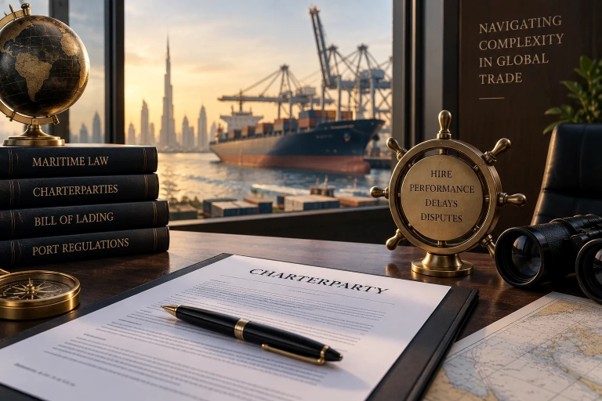
A maritime lawyer should test the charterparty before operational disputes escalate.
A charterparty dispute can begin with something that appears operational. The vessel arrives late, hire is reduced, cargo operations overrun or one party alleges that the ship has failed to perform as agreed. Once those issues affect payments or voyage schedules, the commercial problem can quickly become a contractual dispute.
The UAE’s current maritime framework is Federal Decree-Law No. 43 of 2023 Concerning the Maritime Law, in force since 29 March 2024. It contains separate provisions for bareboat, voyage and time charters while leaving significant room for the parties’ contractual arrangements.
A maritime lawyer reviewing a dispute should therefore start with the type of charter, its governing law, the contractual wording and the operational record behind the claim.
Start With the Type of Charter
Responsibilities differ considerably between bareboat, voyage and time charters.
Under a bareboat charter, the vessel is placed at the charterer’s disposal without crew or provisions, and the charterer generally assumes broader responsibility for its commercial and navigational management unless otherwise agreed. A voyage charter concerns one or more identified voyages, while a time charter makes the vessel available for an agreed period.
Those differences affect management, operating expenses, employment of the vessel and the obligations that may have been breached. A maritime law lawyer should therefore establish the contractual model before analysing individual complaints about payment, delay or performance.
Hire and Freight Claims Need More Than an Invoice
Payment disputes are rarely resolved by looking only at whether an invoice remains unpaid. A time charterer may argue that hire should be reduced because the vessel was unavailable or because a contractual off-hire event occurred. The owner may dispute both the factual basis and the contractual entitlement to make the deduction.
Voyage charter disputes can involve freight, short loading, additional compensation for loading or discharge delays and other payment issues. The charterparty, invoices, notices, payment history and calculations should all be examined together.
Maritime lawyers in Dubai should also identify notice requirements, contractual claim provisions and statutory time limits. Where the UAE Maritime Law governs, Article 136 provides that, in the event of denial and in the absence of a legally admissible excuse, actions arising from a charterparty are not heard after one year from the charterparty’s expiry.
Waiting too long can therefore create a problem that has nothing to do with the merits of the original claim.
Performance Claims Depend on the Contract and the Evidence
Speed and fuel-consumption warranties are common sources of disagreement under time charters. Parties may also dispute whether a breakdown, deficiency, detention or another event brings the vessel within a contractual off-hire provision.
These questions cannot be resolved simply by describing the vessel as “underperforming.” The contractual test needs to be applied to the evidence from the relevant period.
Weather information, noon reports, engine records, bunker consumption figures, voyage instructions and communications between the vessel and the parties may all become relevant. The best maritime law firms should test whether those records support the contractual claim rather than relying on broad operational descriptions.
Port Delay Requires Careful Laytime Analysis
Port delays can transfer significant costs between the parties, particularly under voyage charters.
The UAE Maritime Law contains default rules concerning loading and unloading periods. Under Article 145, loading or unloading time generally begins on the day following the captain’s notification to the charterer that the vessel is ready, subject to the applicable charterparty and the circumstances of the case.
Individual charterparties may contain much more detailed provisions dealing with notices of readiness, laytime, excluded periods and compensation for delay. Where foreign law governs, additional legal tests may also become relevant.
Safe-port or safe-berth disputes should be treated separately. The UAE Maritime Law does not impose a general safe-port warranty in those terms across every charterparty. Where the contract contains such an obligation, liability will depend on its wording, the applicable law, the condition of the port or berth and the instructions given to the vessel.
This is why top maritime law firms distinguish statutory rules from contractual obligations before attributing responsibility for port delay.
Governing Law Can Change the Legal Analysis
Charterparties are frequently international contracts. A vessel may be foreign-flagged, owned by an overseas company, chartered by another foreign business and operating through UAE ports.
Article 130 of the UAE Maritime Law is therefore important. The law of the ship’s flag generally governs the charter unless the parties agree otherwise. The Maritime Law also allows parties substantial freedom to agree different charter terms, subject to the statutory framework and the nature of the charter arrangement.
A dispute governed by foreign law can still involve a vessel, counterparty or asset located in the UAE. This may create separate questions concerning security, interim measures or enforcement.
For this reason, law firms in UAE handling cross-border maritime disputes may need to coordinate the substantive claim with foreign counsel while separately considering any action required in the UAE.
Early Review Matters Before Positions Harden
Charterparty disputes often develop over more than one voyage or payment cycle. Hire deductions accumulate, performance complaints repeat, delay claims remain unpaid and the parties continue operating while their positions become increasingly difficult to reconcile.
Early legal review can identify whether contractual notices are being issued correctly, whether evidence is being preserved and whether any statutory or contractual time limit is approaching.
The work expected of top legal firms in Dubai is not simply to review a clause after the commercial arrangement has already broken down. The legal position should be tested while the operational record is still available and the parties still have options.
Conclusion: Build the Case From the Contract and Voyage Record
A strong charterparty claim usually depends on several pieces of evidence working together. The charterparty establishes the legal obligations. Voyage records show what happened. Notices demonstrate how the parties responded. Payment documents establish the financial consequences.
The role of top law firms in Dubai is to identify which of those facts actually determine liability and the value of the claim.
AY Advocates advises shipowners, charterers, operators and other maritime participants on charterparty disputes, hire and freight claims, performance issues, port delays, demurrage-related claims and other shipping disputes in the UAE. Charterparty disputes can become more expensive with every voyage or payment cycle. Speak with AY Advocates about charterparty, shipping and maritime disputes in the UAE.
FAQs
1. What is a charterparty?
A charterparty is a contract governing the use of a vessel for an agreed period or one or more voyages. The legal position depends on whether the arrangement is a bareboat, voyage or time charter and on the terms agreed by the parties.
2. Can a charterer stop paying hire if the vessel is not performing properly?
Not automatically. The charterparty must be reviewed to determine whether the circumstances fall within an off-hire clause or another contractual right to reduce or withhold payment. The evidence and any notice requirements are also important.
3. What is demurrage in a voyage charter?
Demurrage generally refers to agreed compensation payable where the permitted time for loading or discharge has been exceeded. The exact entitlement and calculation depend on the charterparty and the applicable law.
4. Is there a time limit for charterparty claims under UAE Maritime Law?
Yes. Article 136 provides that, in the event of denial and absence of a legally admissible excuse, an action arising from a charterparty is not heard after one year from the charterparty’s expiry.
5. Does UAE law always govern a charterparty involving a vessel in the UAE?
No. Article 130 provides that the law of the vessel’s flag generally applies to the charter unless the parties agree otherwise. The governing-law clause, dispute-resolution provision and any UAE security or enforcement issues should be reviewed separately.
6. When should a maritime lawyer review a charterparty dispute?
Legal review is useful as soon as hire deductions, performance complaints, port delays, unpaid freight or repeated contractual notices begin to affect the commercial relationship. Early review can preserve evidence, identify approaching time limits and reduce avoidable procedural mistakes.