
August 31, 2026
Divorce in Dubai in 2026: What to Understand Before You File
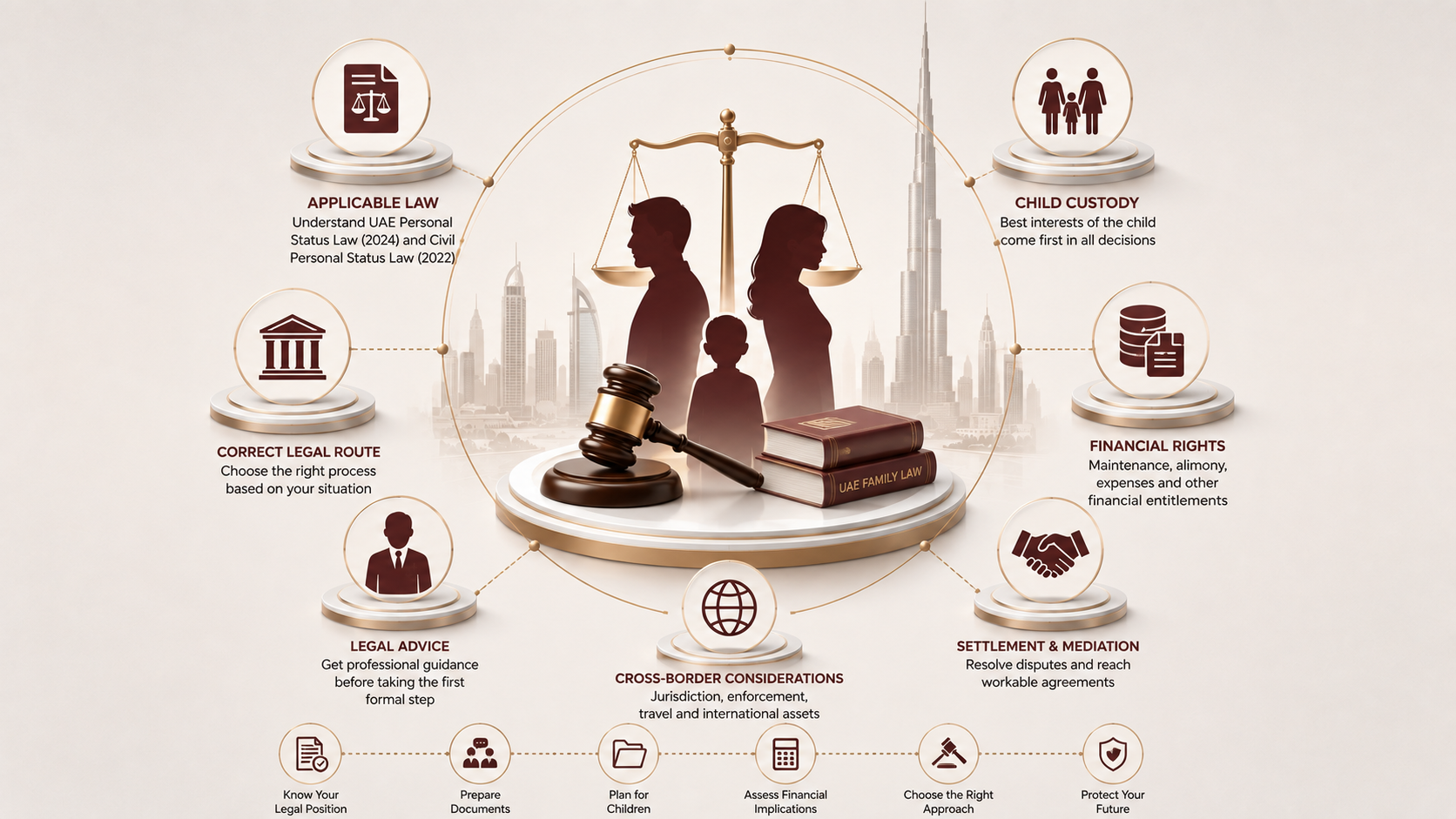
A divorce can affect children, finances, living arrangements and future obligations. Understanding the legal route before proceedings begin can prevent avoidable disputes later.
Divorce in Dubai does not follow one identical process for every couple. Nationality, religion, the law applicable to the marriage, the presence of children and the relief being requested can all affect how a case is handled.
The UAE's current Personal Status Law, Federal Decree-Law No. 41 of 2024, came into force on 15 April 2025 and replaced the previous federal personal status legislation. A separate federal civil personal status regime under Federal Decree-Law No. 41 of 2022 also governs certain non-Muslim personal status matters, subject to its rules on applicable law.
For expatriate families, the first question is therefore not simply how to file for divorce, but which legal framework applies to the marriage and the issues in dispute.
Start With the Correct Legal Route
The legal route can affect the divorce procedure, financial claims and issues concerning children. Under the 2022 civil personal status regime for non-Muslims, either spouse may seek a civil divorce without having to prove fault or harm.
Cases governed by the 2024 Personal Status Law follow a different framework. Rights and procedures can depend on the circumstances of the marriage, the parties involved and the relief sought.
Before proceedings begin, relevant documents should be reviewed carefully. These may include the marriage certificate, passports and nationality documents, any marital agreement, existing court orders and records concerning the children. Where foreign law may be relevant, the requirements for relying on that law should also be considered early.
Treat Children's Issues as a Separate Part of the Case
Ending a marriage does not end parental responsibilities. Custody, guardianship, visitation, maintenance, education, healthcare, travel and daily decision-making may all need to be addressed.
The current Personal Status Law contains detailed provisions on custody and allows the court to consider the child's best interests when determining appropriate arrangements.
A practical parenting arrangement should be specific enough to reduce future conflict. Where parents already disagree, broad promises about contact or decision-making can create further problems.
International families should pay particular attention to travel and relocation. Taking a child outside the UAE can raise separate legal issues, particularly where consent or court approval is required.
Prepare Financial Information Before Positions Harden
Financial claims are easier to assess when the relevant documents are available and the legal basis of each claim is clear.
Depending on the applicable law and circumstances, issues may include post-divorce maintenance or alimony where available under the applicable legal regime, child maintenance, housing costs, school fees, medical expenses, dowry obligations and other financial rights arising from the marriage.
Bank records, salary information, tenancy documents, school invoices, evidence of household expenses and relevant agreements can become important.
A divorce and family lawyer can identify which documents actually support the claims being made. This is more reliable than depending on estimates, verbal promises or assumptions about what one spouse must provide after separation.
Settlement Can Resolve Some Issues Without a Full Dispute
Not every family matter needs to continue to a contested judgment. Where the parties can agree on lawful and workable terms, settlement may reduce the number of issues requiring a court decision.
Depending on the type of family dispute, Family Guidance and Reconciliation procedures may apply before the matter reaches court. However, the current Personal Status Law excludes certain matters from referral where reconciliation is not possible, including applications to establish a divorce.
Civil divorce cases under the 2022 federal regime are also heard directly by the court without referral to Family Guidance Committees.
Any settlement should still be drafted carefully. Terms dealing with children, payments, property-related arrangements or future obligations should be clear enough to understand and implement. An agreement that settles today's dispute but leaves important questions unanswered can create another dispute later.
Do Not Ignore Cross-Border Consequences
Dubai is home to families whose marriages, assets, children and nationalities may connect them to several countries.
A divorce order obtained in the UAE may therefore be only one part of the wider legal position. Recognition of the divorce abroad, enforcement of financial orders, overseas property, foreign proceedings and the legal status of children in another jurisdiction may also require separate consideration.
Before filing, parties with international connections should identify where important assets and family members are located and whether legal steps may also be required elsewhere.
This does not mean every international divorce becomes complex. It means decisions taken in the UAE should be made with their possible overseas consequences in mind.
Get Advice Before Taking the First Formal Step
Family cases are easier to assess when the facts and documents are organised before proceedings begin. Early legal advice can clarify the applicable law, identify urgent concerns, preserve important evidence and determine which issues may be capable of settlement.
AY Advocates advises and represents clients in divorce, child custody, maintenance and wider personal status matters in the UAE. The focus should be on understanding the legal position clearly and choosing a practical approach suited to the circumstances of the family.
FAQs
1. Which law can apply to a divorce in Dubai?
The applicable legal framework depends on the circumstances, including nationality, religion and the law that may properly govern the marriage. The 2024 Personal Status Law and the 2022 Civil Personal Status Law provide different routes, so the position should be assessed before proceedings begin.
2. Do I need a divorce lawyer Dubai-based before filing?
No. Private legal representation is not automatically required in every case. However, a divorce lawyer Dubai-based can assess the applicable law, jurisdiction, evidence, financial claims and children's issues before formal steps are taken.
3. Can parents agree on custody, visitation and maintenance?
Yes. Parents may agree on matters such as custody, visitation and financial arrangements, subject to the applicable law and any required court or judicial approval. Where children are involved, any arrangement must remain consistent with their best interests.
4. What should I check before choosing a family law firm Dubai-based?
Consider the firm's experience with divorce, custody, maintenance and international family matters where relevant. A family law firm Dubai-based should also explain the likely procedure, what can realistically be negotiated and what may require a court decision.
5. Are top legal firms in Dubai or top law firms in Dubai automatically better for a family case?
No. Labels such as top legal firms in Dubai or top law firms in Dubai should not replace an assessment of the lawyers who will actually handle the matter. Relevant family-law experience, court capability, communication and a clear case strategy are more important considerations.
6. When should I speak to a family lawyer Dubai-based?
A family lawyer Dubai-based can be consulted before filing for divorce, where custody or visitation is disputed, where maintenance is uncertain or where an international element affects the family. Law firms in UAE have different practice strengths, so family matters should be handled by lawyers with relevant personal status experience.
Published 31 August 2026