
September 5, 2026
Litigation in the UAE: What to Assess Before Taking a Dispute to Court
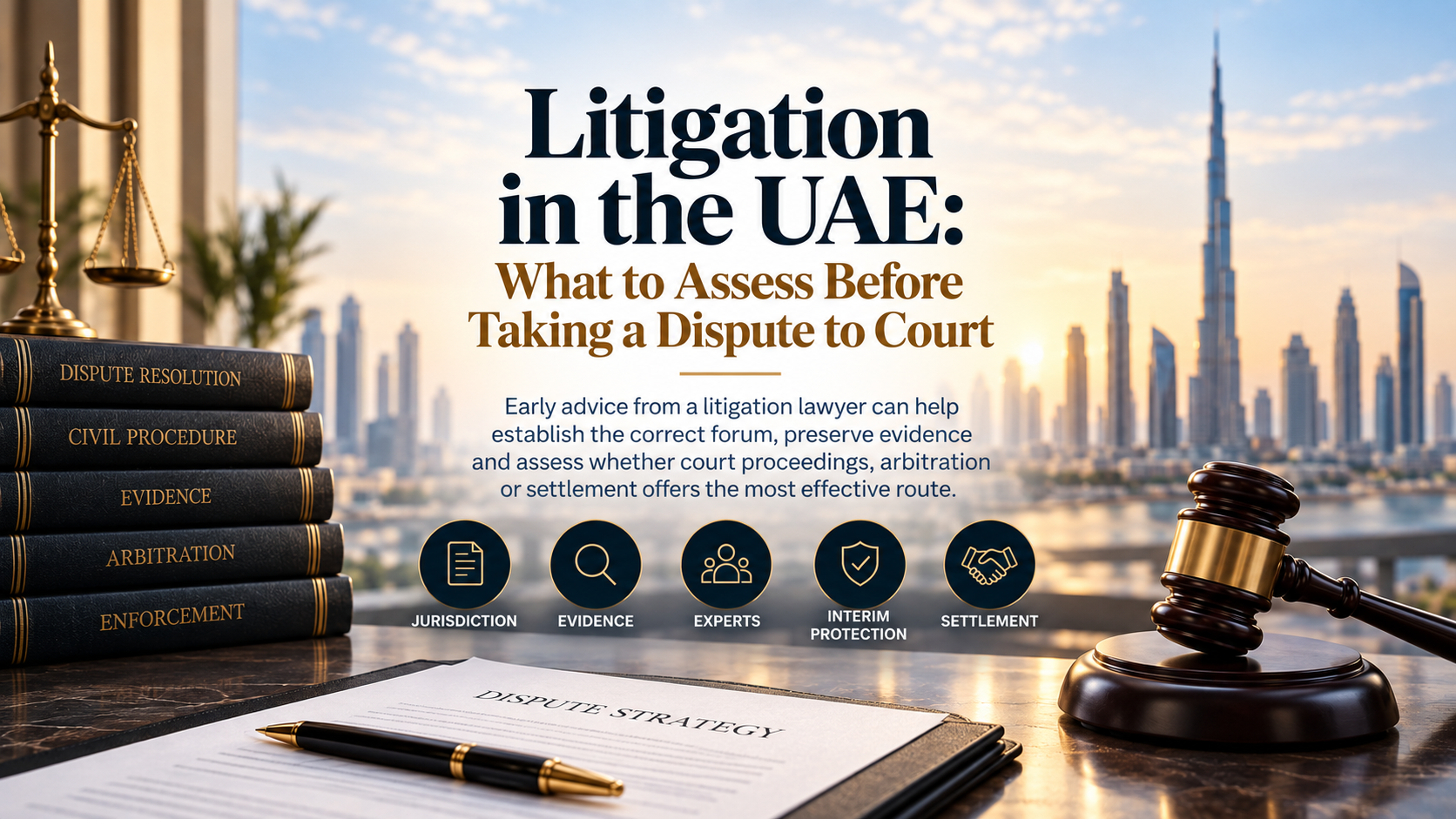
Early advice from a litigation lawyer can help establish the correct forum, preserve evidence and assess whether court proceedings, arbitration or settlement offers the most effective route.
A dispute rarely becomes expensive because of one bad day. More often, cost and risk grow because the legal position was not assessed early enough. Contracts are reviewed too late, evidence is scattered across emails and messaging platforms, and proceedings begin before the parties have decided what result they actually need.
Civil and commercial litigation in the UAE is principally governed at federal level by Federal Decree-Law No. 42 of 2022 on Civil Procedure, as amended, together with Federal Decree-Law No. 35 of 2022 on Evidence in Civil and Commercial Transactions. The procedural framework was amended again in 2025, including changes concerning specialised courts and technical expertise. A sensible dispute strategy should therefore begin with jurisdiction, evidence and recovery, not simply with filing a claim.
Read the Contract Before Choosing the Forum
The first question is where the dispute should be heard. A contract may provide for UAE onshore courts, arbitration or a court within a financial free zone. Jurisdiction can also depend on the parties, subject matter, place of performance and applicable procedural rules. Starting proceedings in the wrong forum can create unnecessary delay and expense.
When a business consults a litigation lawyer, Dubai-related disputes should be checked first for any jurisdiction or arbitration clause. Federal Law No. 6 of 2018 continues to govern arbitration at federal level. If a valid arbitration agreement covers the dispute, ordinary court proceedings may not be the correct route. This needs to be assessed before substantive procedural steps are taken.
Build the Case Around Evidence
A strong commercial complaint is not automatically a strong court case. The facts still need to be proved. Contracts, amendments, invoices, delivery records, notices, account statements, board approvals and correspondence may all become important depending on the claim.
Federal Decree-Law No. 35 of 2022 expressly recognises electronic evidence, including information generated, stored, transmitted or received through information technology. Emails, electronic records and other digital material can therefore be relevant evidence. Litigation & dispute resolution lawyers should help preserve important records early, particularly where staff changes, automatic deletion policies or changing business systems could affect access to material later.
Take Expert Evidence Seriously
Many UAE disputes involve technical questions that cannot be resolved from the contract alone. Construction claims may require engineering analysis. Financial disputes may require accounting work. Valuation, defects, quantities or complex calculations can also require specialist input. Courts can appoint experts to examine technical matters and report on issues within their expertise.
The expert stage should not be treated as an administrative formality. The quality of the records provided, the chronology and the explanation of technical issues can affect how the dispute is understood. A litigation law firm should prepare this stage carefully while recognising that the court, not the expert, ultimately determines the case.
Consider Interim Protection Where It Is Justified
Sometimes the real concern is not obtaining a judgment but preserving the ability to enforce it. The Civil Procedure Code recognises precautionary measures in circumstances where legal requirements are met and a right may otherwise be placed at risk.
That does not mean an asset-freezing or attachment application is available in every monetary dispute. The factual basis, urgency and statutory conditions must be considered carefully. Advocates and legal consultants in Dubai should assess whether interim relief is legally justified rather than treating it as an automatic step whenever a claim is filed.
Settlement Can Be Part of the Strategy
Litigation does not always have to end with a final judgment. Federal Decree-Law No. 40 of 2023 provides a framework for mediation and conciliation in civil and commercial disputes, including judicial and extrajudicial mediation. This gives parties another route where a negotiated result may be commercially preferable.
Settlement should be compared with likely recovery, legal cost, management time, confidentiality concerns and the future relationship between the parties. The qualities expected from top dispute resolution law firms include knowing when continued proceedings are justified and when a properly documented settlement offers the stronger commercial outcome. Any settlement should clearly address payment, releases, confidentiality and what happens if its terms are breached.
Think About Enforcement Before Filing
A judgment is useful only if it produces a practical result. Before proceedings begin, a claimant should consider where the defendant and relevant assets are located, whether guarantees or security exist, and whether enforcement may eventually be required in another jurisdiction.
For lawyers in Dubai handling cross-border disputes, enforcement can influence the choice between litigation, arbitration and settlement. Recognition rules can differ depending on whether the outcome is a court judgment or arbitral award, the jurisdiction involved and any applicable treaty. Dispute planning should therefore consider recovery at the beginning rather than after significant costs have already been incurred.
Conclusion
The best legal companies do not treat dispute resolution as a race to file first. A better process is to establish the forum, secure the evidence, quantify the claim, identify procedural risks and decide what a commercially useful outcome looks like. This disciplined approach is also what businesses should expect when assessing top law firms in Dubai for complex contentious work.
AY Advocates advises and represents businesses and individuals in civil and commercial disputes in the UAE, including contractual claims, payment disputes, shareholder matters, property-related claims and other contested matters. Early legal assessment can help identify the appropriate forum, evidence requirements, interim options and realistic routes to recovery.
If a dispute has arisen or appears likely, contact AY Advocates for an assessment before important rights, evidence or procedural options are lost.
Frequently Asked Questions
1. Does every commercial dispute in the UAE have to go to court?
No. The contract and circumstances should first be reviewed for an arbitration agreement, jurisdiction clause or another dispute resolution mechanism. Mediation or settlement may also be appropriate in some cases.
2. Can emails and electronic records be used as evidence in a UAE civil case?
Yes. Federal Decree-Law No. 35 of 2022 expressly recognises electronic evidence. Whether particular material proves the issue in dispute will depend on its content, authenticity and the circumstances of the case.
3. Can a UAE court appoint an expert in a commercial dispute?
Yes. Courts can appoint experts where technical matters require specialist assessment. Accounting, engineering, construction and valuation issues are common examples.
4. Can assets automatically be frozen whenever a lawsuit is filed?
No. Precautionary attachment and other interim measures are subject to legal requirements. The applicant must establish the relevant statutory basis rather than simply show that a dispute exists.
5. Can parties settle after court proceedings have already started?
Yes. Settlement can remain possible during a dispute. UAE law also provides mechanisms for judicial and extrajudicial mediation in civil and commercial matters.
6. Why should enforcement be considered before filing a claim?
Obtaining a favourable judgment does not necessarily guarantee recovery. Understanding where the opposing party and its assets are located can help shape the forum, litigation strategy and overall commercial decision before significant costs are incurred.
Published 5 September 2026