
September 5, 2026
Banking and Finance in the UAE: What Businesses Should Review Before Signing a Facility Agreement
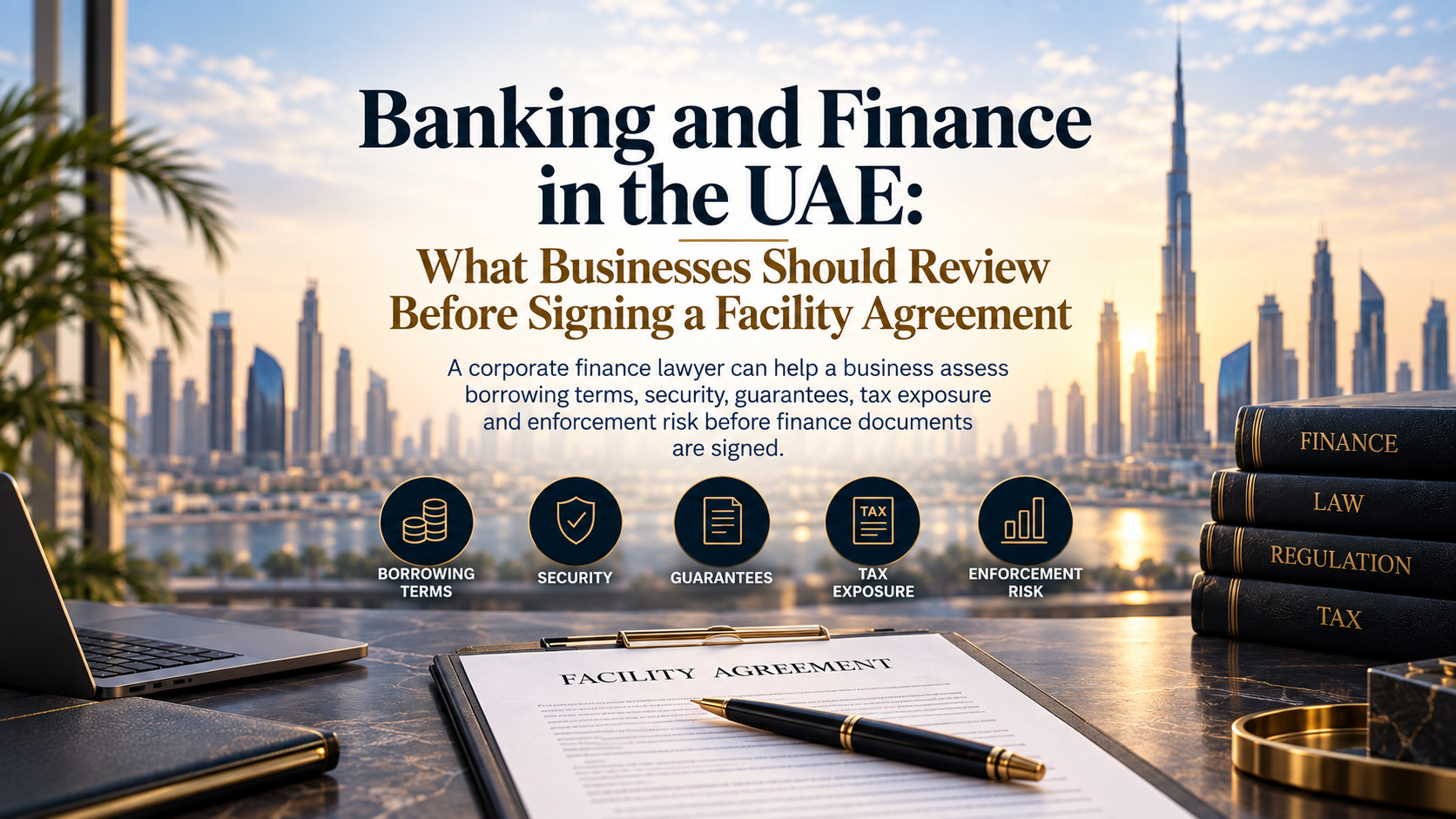
A corporate finance lawyer can help a business assess borrowing terms, security, guarantees, tax exposure and enforcement risk before finance documents are signed.
Business finance is often negotiated around a few headline points: the amount available, pricing, repayment period and security required. Those terms matter, but they do not show the full legal position. Once a facility agreement is signed, the borrower may also be committing to financial covenants, information duties, restrictions on further borrowing, security arrangements, guarantees and events that allow the lender to accelerate repayment.
The law in banking and finance in the UAE comes from several sources. Federal Decree-Law No. 6 of 2025 now governs the Central Bank, licensed financial institutions and regulated financial activities at federal level. Financing transactions can also involve the Commercial Transactions Law, company law, movable security rules, tax law and the contractual terms agreed between the parties. The legal review therefore needs to match the particular transaction rather than rely on a standard checklist.
Understand the Facility Before Focusing on the Rate
A financing proposal should be reviewed as a package. Interest or profit rate is only one part of the cost. Arrangement fees, commitment fees, default pricing, early repayment charges, hedging requirements and other finance costs can materially affect the economics of the facility. The agreement should also be checked against the term sheet so that commercial points negotiated at the beginning have been carried into the final documents correctly.
The operational obligations deserve the same attention. A borrower may be required to deliver financial statements, maintain particular ratios, obtain lender consent before disposing of assets or taking additional debt, and notify the lender of specified events. Lawyers specializing in banking law should identify which obligations are absolute, which contain negotiated thresholds and which could be triggered by events outside the borrower's immediate control.
Security Changes More Than the Lender's Risk
Many corporate facilities are supported by security. Depending on the structure, this may include security over receivables, equipment, accounts, shares or other assets, together with guarantees from a parent company, shareholder or related entity. Federal Law No. 4 of 2020 provides a framework for security rights over movable property and an electronic registration system for rights falling within its scope.
For the borrower, the question is not simply whether security must be given. The business should understand what assets are covered, whether future assets or proceeds are included, what restrictions apply to dealing with secured assets, and what happens if another lender later requests security over the same property. A banking law practice should also review the perfection and registration steps relevant to the particular security rather than assuming that signing the security document completes the process.
Check Who Has Authority to Borrow and Guarantee
Financing documents need to be signed by people with proper authority, but authority should be checked at company level before execution. The company's constitutional documents, legal form, board or shareholder approvals and existing financing arrangements may all affect the approvals needed for borrowing, granting security or issuing a corporate guarantee.
This becomes especially important in group financing. A subsidiary may be asked to secure another group company's debt, or a parent may provide a guarantee for a borrower. Advocates and legal consultants in Dubai reviewing the transaction should consider corporate authority, the commercial purpose of the arrangement and any restrictions arising from the company's legal form or constitutional documents. A guarantee should never be treated as a routine attachment merely because it appears in the lender's standard document set.
Regulation Matters to the Structure of the Transaction
Federal Decree-Law No. 6 of 2025 identifies activities that require Central Bank licensing, including taking deposits and providing credit or funding facilities. It also prohibits carrying on licensed financial activities without the required licence. This distinction matters when financing is being provided, arranged or promoted as a business rather than arising as an isolated commercial arrangement.
For lawyers in Dubai working on cross-border or group finance, the parties, location and nature of the activity should therefore be identified early. Transactions involving a financial free zone, foreign lender, Islamic financing structure or regulated financial institution may require additional analysis. The legal framework should be established before documents are adapted from another jurisdiction.
Financing Can Also Affect the Tax Position
Borrowing decisions can have Corporate Tax consequences. UAE Corporate Tax rules contain limitations on the deduction of net interest expenditure. Under the general limitation rule, where it applies, deductible net interest expenditure is generally limited by reference to the greater of 30 per cent of adjusted EBITDA or the AED 12 million de minimis threshold, subject to the statutory rules and exclusions.
There is also a specific limitation for certain loans obtained from related parties and used for specified transactions, unless the conditions for the exception are satisfied. A corporate finance lawyer should therefore coordinate legal documentation with the company's tax analysis where debt structure, related-party funding or significant interest expense is involved. The best legal companies in finance work recognise that a facility can be legally valid while still producing an unintended tax result.
Conclusion: Plan for Default Before There Is a Default
Events of default can extend beyond a missed payment. Depending on the negotiated agreement, they may include breach of covenant, misrepresentation, insolvency-related events, cross-default or failure to maintain security. The consequences can include cancellation of commitments, acceleration of the debt and enforcement of security, subject to the agreement and applicable law.
Work associated with top law firms in Dubai should therefore include testing the default provisions against realistic business scenarios before signing. A company should know which breaches have cure periods, which thresholds apply and what reporting obligations arise when a problem develops. Clear drafting at the beginning gives both sides a more predictable framework if the financing relationship later comes under pressure.
AY Advocates advises businesses on banking and finance transactions, facility documentation, corporate approvals, security, guarantees and related commercial issues in the UAE. Legal review before execution can help a borrower understand both the immediate financing terms and the obligations that will continue throughout the life of the facility.
If your business is negotiating new finance, refinancing existing debt or reviewing security and guarantee arrangements, contact AY Advocates to discuss the transaction before the documents are finalised.
Frequently Asked Questions
1. Does every corporate financing arrangement require a Central Bank licence?
No. The licensing analysis depends on the activity being carried out and the circumstances in which financing is being provided, arranged or promoted. Federal Decree-Law No. 6 of 2025 identifies financial activities that require Central Bank licensing, including the provision of credit and funding facilities.
2. Can movable business assets be used as security for financing in the UAE?
Yes. Federal Law No. 4 of 2020 provides a framework for creating security rights over various forms of movable property. The requirements depend on the asset and the particular security arrangement.
3. Is signing a security agreement enough to protect a lender against third parties?
No. Depending on the type of asset and security, registration, possession, control or another legally recognised step may be relevant. The required perfection process should be checked for each security interest.
4. Is all interest paid on corporate borrowing deductible for UAE Corporate Tax purposes?
No. UAE Corporate Tax legislation contains both general and specific restrictions on the deduction of interest expenditure. The applicable treatment depends on the amount, nature and purpose of the financing and whether any statutory exception applies.
5. Should corporate approvals be obtained before finance documents are signed?
Yes. The company's legal form, constitutional documents and transaction structure should be reviewed to determine what board, shareholder or other corporate approvals are required for the borrowing, guarantee or security.
6. What should a business review besides the interest rate in a facility agreement?
The business should examine repayment provisions, fees, financial and operational covenants, representations, information obligations, security, guarantees, events of default, acceleration rights and any restrictions that could affect future business decisions.
Published 5 September 2026